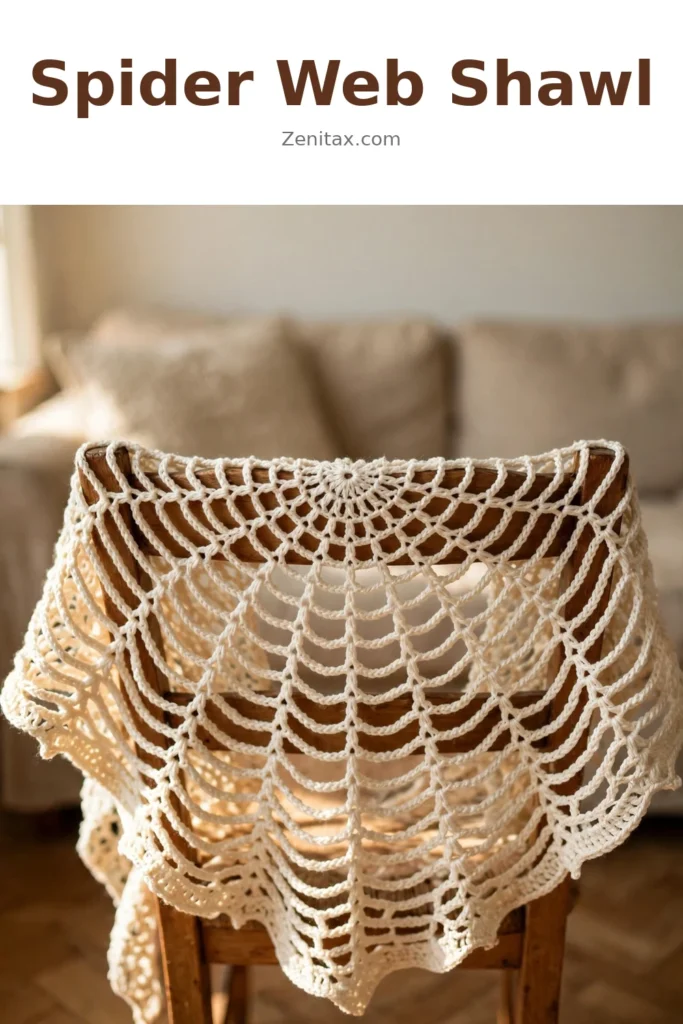
A crochet spider web shawl worked in open rounds so the web pattern actually reads from across a room. Black is the obvious choice but deep purple or grey holds the shape just as well. Wearable well past Halloween if you don’t lean too hard into the theme, which is more than most costume pieces manage. Full pattern’s written out.
Web-structure crochet shawls work from a single center point and expand outward through a combination of chain loops and joining stitches that leave most of the fabric open. The spiderweb version takes that construction logic and makes the web shape the entire point rather than a background texture. Working in a plain cream or white yarn lets the geometry carry the piece without any color distraction pulling attention away from the pattern.
Crochet Spider Web Shawl
This crochet spiderweb shawl starts at a small center cluster at the top of the triangle and builds outward row by row using long chain arcs connected at evenly spaced spoke points. Each row adds width along the curved bottom edge while the spoke lines remain consistent from center to hem, which is what gives the finished piece its clean web appearance. The open construction uses very little yarn relative to its finished size, making it a fast project despite the detailed final look.
Quick Facts
- Difficulty: Beginner — two stitches only (double crochet and chain)
- Time: Approximately three hours for a full wearable size
- Sizing: Fully adjustable — work as many rows as you need
- Finished shape: Semi-circle shawl
Customization Ideas
Before the pattern, a few directions worth considering.
The size is the most flexible variable here — because the row count controls the finished dimensions, you can stop at a small shoulder wrap, continue to a generous full shawl, or push further to a dramatic floor-length piece for a costume.
Color is the second decision. White on its own is classic and web-like. Black is sleek and wearable outside Halloween. A deep charcoal with a thin strand of silver held alongside it adds shimmer without changing the construction at all. For a beginner gift, work a small version in a recipient’s favorite color and finish the edge with a simple single crochet border in a contrasting shade.
The starting stitch count is also adjustable. The pattern begins with 10 double crochets in the foundation loop, which gives a standard semi-circle proportion. Dropping to 7 or 8 creates a narrower, more pointed shawl shape that sits closer to a capelet. Going above 10 widens the fan and produces a flatter, more open arc. If you change this number, keep it consistent with your visual goal and work a small swatch of a few rows to see how the proportion feels before committing to the full piece.
Materials and Tools
- Any yarn of your choice in the weight that suits your intended use; the original uses a worsted weight white yarn, which moves quickly and gives good stitch definition in the chain spaces
- 4.5mm crochet hook
- Scissors and a tapestry needle for weaving ends
The yarn weight is worth thinking about before you start. Worsted at 4.5mm gives a sturdy, opaque fabric where the chain spaces read as clean geometric gaps. A DK or fingering weight on the same hook would produce a lacier, more fluid result with longer drape. Sport weight is a good middle ground if you want something lighter than worsted but with more body than a fine yarn. The pattern works at any weight as long as you pair it with a hook that gives you an open, relaxed gauge rather than a dense one.
Tips
- Work the foundation loop loosely. All 10 double crochets need to sit comfortably in that first loop without crowding, and a tight foundation will pull the whole shawl into a cup shape rather than lying flat.
- Count your double crochets at the end of Row 2 before moving on. If you have the right number there, the rest of the pattern is simply adding one chain per row and the stitch count cannot drift. If something is off in Row 2, catching it early saves a lot of frogging.
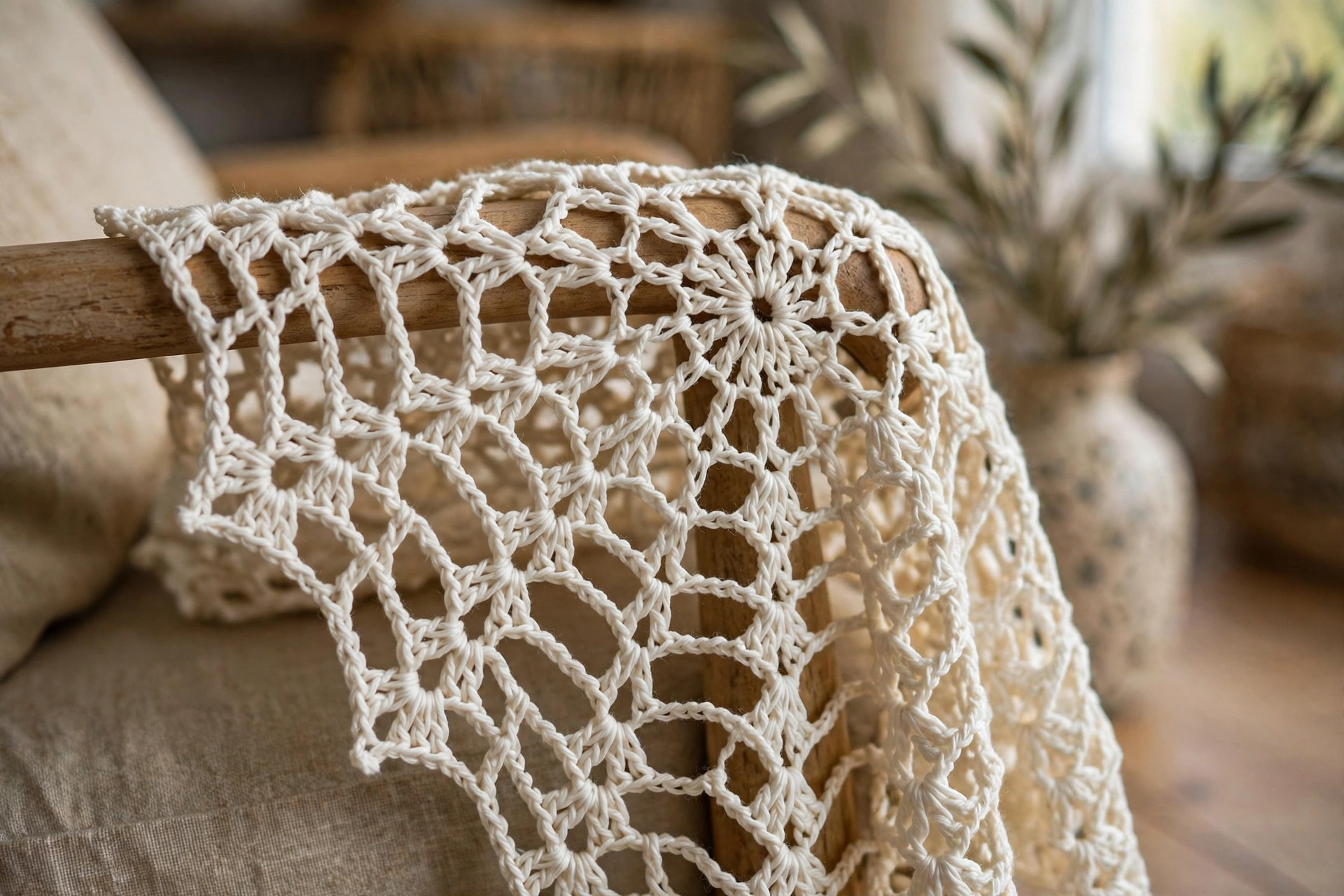
- Block the finished shawl before wearing. Wet block by soaking briefly, squeezing out excess water, and pinning the semi-circle flat to dry. The chain spaces open up noticeably and the web effect becomes much crisper.
The Pattern
Foundation
Make a slip knot and chain 3. This chain-3 counts as your first double crochet throughout the pattern.
Row 1
- Work 9 double crochets into the original foundation loop, for a total of 10 double crochets in that loop.
- This creates your base semi-circle shape.
- Note: If you prefer a smaller or more pointed arc, you may begin with 7 or 8 double crochets instead.
Row 2
- Chain 4. This counts as a double crochet plus 1 chain.
- Work a double crochet, then chain 1, into each stitch from the previous row.
- End the row with a double crochet worked into the 3rd chain of your original chain-3.
Row 3
- Chain 5. This counts as a double crochet plus 2 chains.
- Work a double crochet into the next double crochet, then chain 2.
- Repeat — double crochet, chain 2 — all the way across the row.
Row 4
- Chain 6. This counts as a double crochet plus 3 chains.
- Work a double crochet into the next double crochet, then chain 3.
- Repeat — double crochet, chain 3 — all the way across the row.
Continuing the Pattern
- For every row that follows, add one more chain to the between-stitch chain count.
- Row 5 uses chain 4 between double crochets, Row 6 uses chain 5, and so on, with each row’s turning chain adjusted to match.
- Continue adding rows until the shawl reaches your desired size.
Frequently Asked Questions
How do I know when the shawl is big enough? Hold it up against your back from time to time as you work. A shoulder wrap is done when the straight edge spans your shoulders. A full shawl typically reaches hip or mid-back length. Because every row adds both depth and width simultaneously, the piece grows faster than it feels like it should — check against your body every four or five rows rather than waiting until you think you are close.
Can I use a different hook size? Yes. A larger hook makes the chain spaces more open and produces a lighter, more fluid drape. A smaller hook tightens the spaces and gives a stiffer result. The pattern logic stays identical regardless of hook size; only the finished dimensions change. If you want a very large shawl without working dozens of rows, moving up to a 6mm or 6.5mm hook with the same yarn is a legitimate shortcut.
Does it matter what order I work the stitches in each row? The pattern is directional — you always start from the same end of the semi-circle and work to the other. The turning chain at the start of each row stands in for the first double crochet, so do not work a separate double crochet into the same stitch after chaining. That is the one structural rule that keeps the edge even.
How do I finish the edge cleanly? A single round of single crochet worked all the way around the outer curved edge and down both straight sides gives a tidy, stable border. Work it in the same yarn color for an invisible finish or in a contrast color to frame the shawl. If you want a more decorative edge, a shell stitch or picot border both suit the open lace structure of the body.
Final Thoughts
The pattern logic stays identical regardless of hook size; only the finished dimensions change. Whether you stop at a small shoulder wrap or push further to a dramatic full-length piece, this shawl is a joy to make and wear. Work it in white for the classic web look, in black for a sleek year-round accessory, or in your own favorite color. The geometry does all the work — all you need is a hook and a little patience.